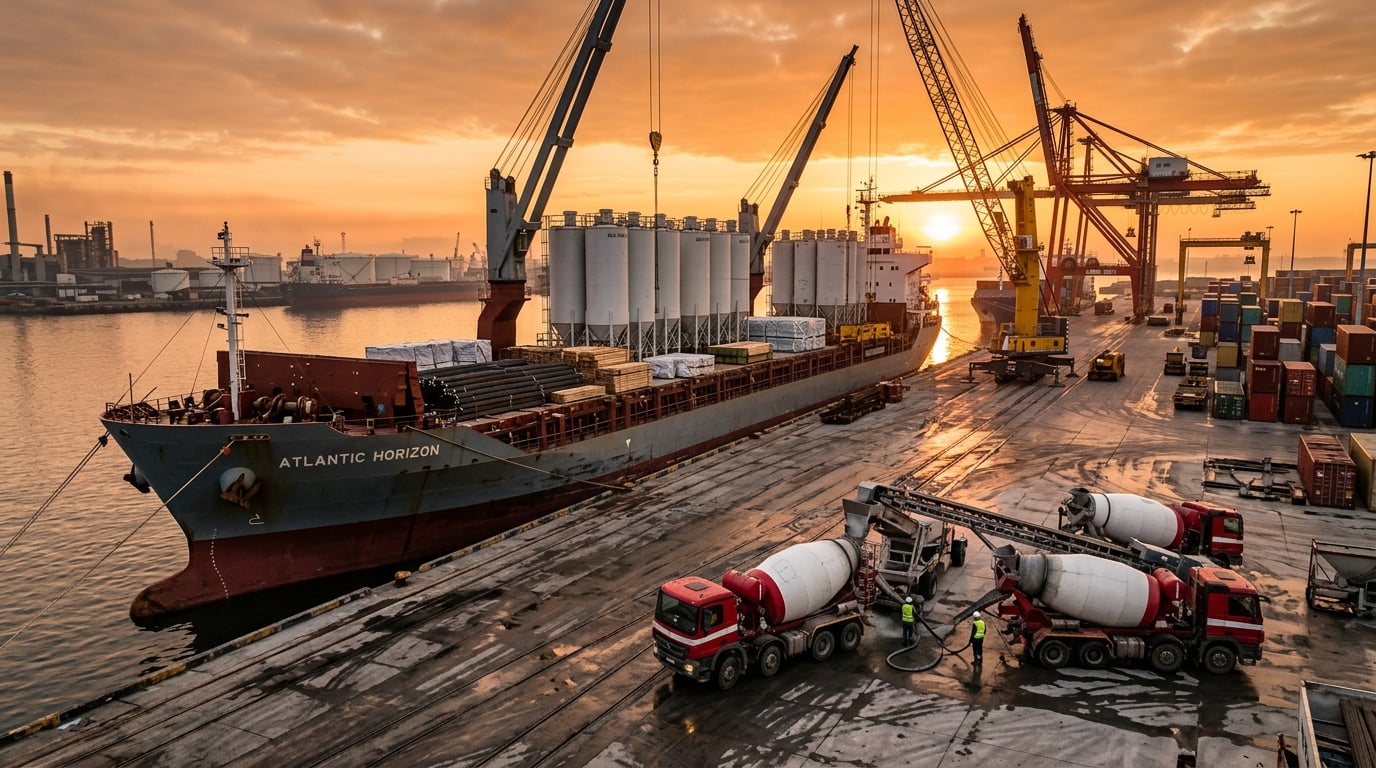
Back in April 2025, the U.S. slapped a 25% tariff on imported cement. We import somewhere around 20 to 25 percent of our total cement supply in this country. Thankfully, the renegotiated USMCA reduced the tariff on cement coming from Canada and Mexico to near 0%. But the USMCA doesn't apply to Turkey (10%), Greece (20%), Vietnam (20%), and Japan (10%). When you place a duty on that material, the cost doesn't just disappear. It gets passed down the chain. Sometimes it lands on the ready-mix producer trying to figure out how to price a yard of concrete without losing the job or losing the customer.
I've talked to guys who are seeing $5 to $10 per ton increases on the cement side alone. And yeah, cement is only 10 to 15 percent of your total concrete cost, so the math doesn't sound catastrophic on paper. But all us ready mix guys have been there when you lose customers over $1/yd increases. It's maddening. You add that to everything else that's gone up, and you start to feel it. Especially in markets like New York, Texas, and the Pacific Northwest where imports aren't just a backup plan, they're part of the regular supply picture.
The Part That Actually Worries Me
Look, I'm not here to argue trade policy. That's above my pay grade and honestly it's one of those topics where I'd rather just end the podcast than go down that road. But what does worry me is the supply side of this thing.
You can't just build a new cement plant in a year. It takes two to three years minimum, and that's if everything goes right and you can get the permits. So in the meantime, domestic producers are running at about 76 percent capacity utilization. That's below the 80 percent threshold where they start feeling comfortable. And the demand side isn't exactly roaring right now either. The market's kind of sitting at the bottom of a cycle, with residential construction still sluggish because of interest rates and commercial office space still figuring out what it wants to be.
So you've got this weird situation where demand is soft but costs are up. And that's a tough place to be if you're a ready-mix producer trying to hold your margins together.
What I've been watching is the vertical integration play. The big cement companies are out there buying ready-mix businesses right now. CRH, Heidelberg, Quikrete, and others. They're not doing that because they're bored. They're doing it because controlling the downstream gives you pricing power and supply chain security that you just can't get any other way. When you own the quarry, the kiln, and the batch plant, you've got a lot more levers to pull when things get weird.
What This Means for the Guys Actually Running Plants
Here's what I keep coming back to when I talk to producers. The guys who are going to come out of this period in the best shape are the ones who are already thinking about their material mix. Not just cement, but the whole picture. What SCMs are you using? What's your fly ash situation? Are you locked into one supplier or do you have options?
I was talking to a guy not too long ago who had been running the same mix design for about eight years. Same cement, same source, same everything. And when his cement costs jumped, he had no flexibility. He hadn't built any relationships with alternative suppliers, hadn't tested anything new, hadn't even looked at what else was out there. And now he's scrambling.
That's the lesson. The guys who built those relationships before they needed them are the ones who have options right now. The guys who waited until the price went up to start making calls are the ones paying full freight.
I know that sounds like I'm just pitching SCMs because that's what I sell. And yeah, I'm not going to pretend I don't have a dog in this fight. But I've been saying this for years before the tariffs were even a conversation. Diversify your material inputs. Know your suppliers. Build those relationships when things are good so you've got somewhere to turn when things get complicated.
One More Thing Worth Paying Attention To
The NRMCA just named a new CEO, Jim Riley, who came over from the National Stone, Sand and Gravel Association. And they've launched this "America 250" campaign to highlight what ready-mix concrete has meant to this country over the last 250 years. Which, honestly, is a pretty cool thing to think about. Every road, every bridge, every hospital, every school. Concrete was there.
And ConcreteWorks 2026 is coming up in October in Nashville. Gaylord Opryland. If you've never been to that show, you need to go. It's the best show in our industry, I'll say it every time. Intimate, focused, full of people who actually know what they're talking about.
But here's the thing about the America 250 campaign that I think is worth sitting with. We're celebrating 250 years of building this country with concrete. And right now, in 2026, we're having a real conversation about whether we can reliably supply the material to keep doing that. That's not a doom and gloom take. It's just a real one.
The industry's going to figure this out. It always does. But the producers who are going to be in the best position on the other side of this are the ones who are paying attention right now, building relationships, diversifying their inputs, and not just waiting for the market to fix itself.
At the end of the day, the dollars are always going to do the talking. So let's make sure we're in a position where we've got something to say.
Found this useful? Share it with your crew.