
Here's something that's been rattling around in my head for a few weeks now. More and more producers are rolling out in-transit slump monitoring systems across their fleets. Some of these deployments are hitting 300-plus trucks. And the thing that keeps jumping out at me isn't the technology itself, it's what makes it actually work.
Driver adoption.
The drivers actually use it. They don't fight it, they don't ignore it, they don't find a workaround. They use it. And that's the whole ballgame right there.
I Like the Data
I've built two concrete labs. I've got the ACI and NRMCA certs to levels that are unnecessary. I've spent more time than I care to admit staring at mix designs and trying to figure out why a load that looked good in the lab, left the plant looking perfect, and then showed up on the job site looking like something else entirely. And here's the thing I kept coming back to: the slump test is a snapshot. One moment in time. You run it at the plant, you write down the number, and then that truck drives 45 minutes in August heat and the concrete keeps doing what concrete does. Hydrating. Stiffening. Changing.
So what exactly did that slump number tell you? It told you what the concrete was doing when it left. Not when it got there. More and more I'm thinking that if you're running a plant in 2026 and still relying only on that one test at the gate, you're flying a little bit blind between the plant and the pour. And that's assuming you even slumped it at the plant!
What In-Transit Monitoring Actually Does
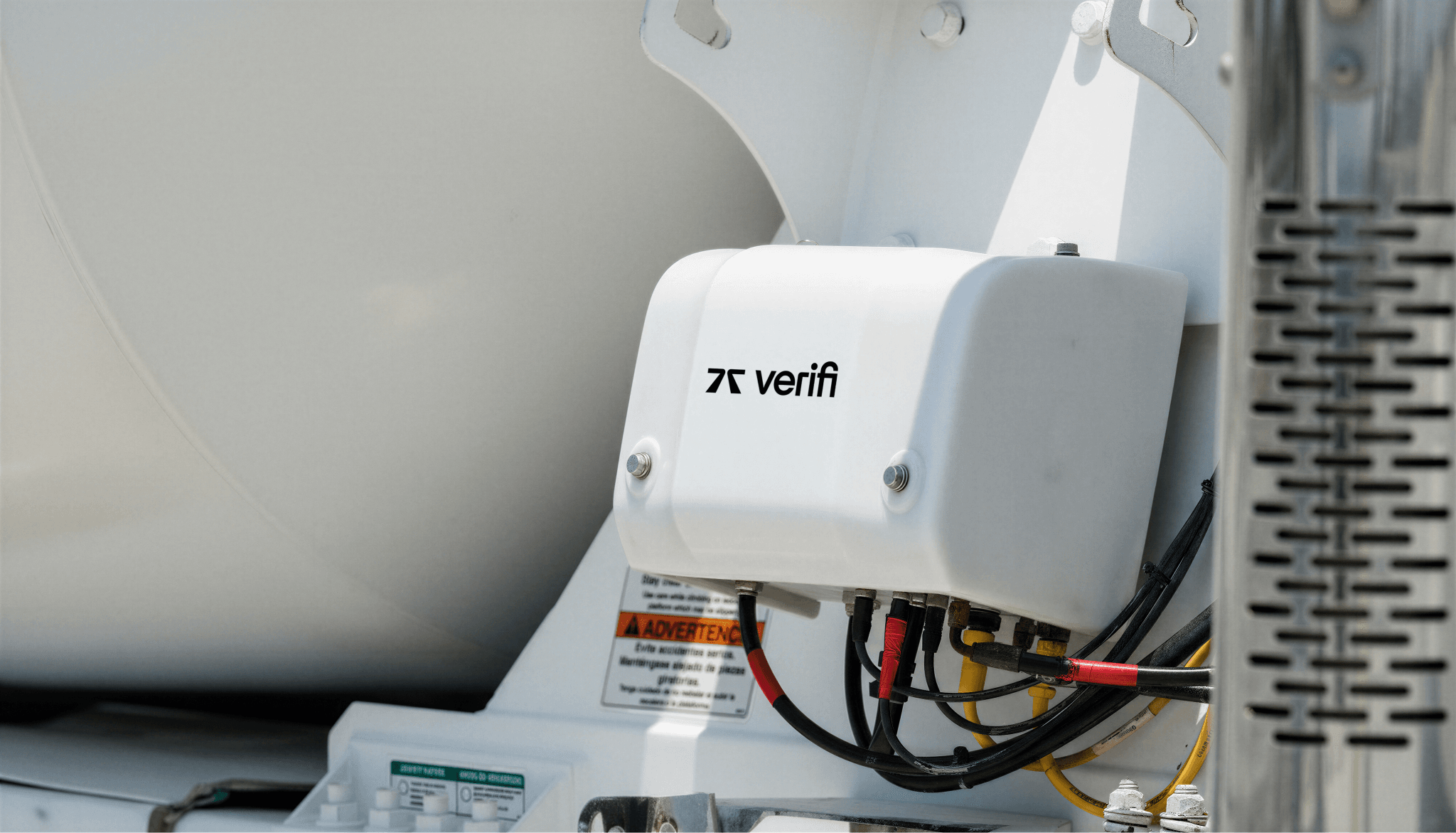
The way these drum-mounted sensor systems work is they use panels installed on the barrel of the ready-mix truck to track slump, air content, temperature, and volume in real time while the truck is rolling. No invasive modifications, no complicated setup. The driver sees it on a display. The plant sees it too.
And here's where it gets interesting for a ready-mix producer. You're not just getting a record of what happened. You're getting a chance to actually do something about it before the truck discharges down the chute. That's a fundamentally different thing.
Tim Hurtack talked about this when he came on the podcast. Tim's the QC Manager at Silvi Group, running quality across dozens of concrete plants in the Philadelphia and New Jersey area. They fit their trucks with sensor panels on the drum that monitor air content and temperature in real time. And the thing Tim kept coming back to was how it changed what his team could actually see. "I have access to all of the trucks through an internet connection," he said. "Anywhere I'm at that I have a cellphone or a laptop with internet, I can monitor any one of those trucks. I can see what the concrete temperature is, I can see what the air content is, I can see which way the barrel's turning."
That last part matters more than you'd think. Because when Tim's team started watching the data, they noticed something. Drivers were locking their drums into automatic control at one or one-and-a-half RPMs going down the road. And the concrete was falling apart — air dropping, slump tanking. It wasn't a mix problem. It wasn't an admixture problem. It was a haul problem. Once they told the drivers to bump the RPMs up to three or four during transit, the air stabilized and the slump held. Just like that.
The Satellite Plant Problem
But here's the piece that really got me thinking about the broader implications for our industry. Tim's running dozens of plants. Some of those are high-horsepower operations cranking out a thousand, fifteen hundred yards a day. And then he's got smaller satellite plants doing two or three hundred yards. He doesn't have QC techs to station at every single location. Nobody does.
So what do you do with that satellite plant an hour and a half down the road when your QC staff is at a major pour? Before these sensors, the answer was basically: hope for the best. Send a tech out when you can. React when something goes wrong.
With the sensor system, Tim can sit at his main office and remotely monitor what the concrete is doing at every plant in the fleet. He doesn't need a technician physically standing there with a slump cone and an air pot. He can see the data in real time and make calls from wherever he is. That's not a convenience upgrade. For a multi-plant producer trying to maintain consistent quality across a spread-out operation, that's a fundamental shift in how QC works.
And the accountability piece is real too. Tim put it pretty bluntly, you can see exactly when a driver adds water between the plant and the job site. The barrel revs up, the air spikes, and the data tells the story. "You always ask them, 'Hey how much water did you add?' 'Oh I didn't touch it, I didn't touch it,'" Tim said. You can hear the guys laughing, but the underlying point is serious. That data trail changes the conversation.
What This Means at the Plant Level
Here's what I'd actually think about if I were a ready-mix producer looking at this stuff right now.
First, the quality control angle is real. If you're overdesigning mixes to cover for variability you can't see, and most of us are doing some version of that, then better in-transit data gives you a path to tighten that up. Tim described how they used to intentionally batching concrete out of spec — higher air, looser slump — just hoping it would land in spec at the jobsite. That's not QC. That's guessing with extra steps. The sensor data gave them the information to stop doing that and start batching to actual targets.
Second, the liability piece matters more than people want to admit. When a break comes back low and the contractor's pointing at you, what do you have? You've got a batch ticket and a slump at the gate. That's it. A system that gives you a continuous record of what that concrete was doing from the plant to the pour, that's a different conversation with your customer. That's data. And data is a lot better than "I'm pretty sure it was fine when it left."
Third, and this is the one I think gets overlooked, it's a driver tool, not just a management tool. The producers who are going to get the most out of this are the ones who frame it that way. Not "we're watching you" but "here's information that helps you do your job better." Tim's team didn't use the sensors to write guys up for adding water. They used the data to figure out that the drum speed was the real culprit and then educated the drivers on what to change. That's the difference between a tool that gets used and a tool that gets ignored.
So Where Does This Go?
For the multi-plant operators out there, especially the ones running satellite locations where a QC tech can't be on site every day — this is where the technology pays for itself. The ability to remotely verify what your concrete is doing across your entire fleet, from your phone, while you're an hour and a half away at your main lab? That changes the math on how many plants you can effectively manage without compromising quality.
ConcreteWorks is coming up in October in Nashville. I'd bet good money this is going to be one of the bigger conversations on the show floor. And if you're going, it's worth spending some time with the folks who are actually running these systems, not just the ones selling them.
Because the concrete doesn't stop changing just because the truck left the plant. And the sooner we build our QC process around that reality, the better off we're all going to be.
Found this useful? Share it with your crew.